
You made it through pregnancy, labour, and delivery. Now you’re finally home with your baby. But somewhere between the middle-of-the-night feeds, the endless lifting, and the hours of holding your little one, you start to notice something: a sharp, nagging pain at the base of your thumb. It aches when you pick up your baby. It throbs when you lift your coffee mug. It shoots up your forearm when you turn your wrist.
You’re not imagining it. You’re not being dramatic. And you are absolutely not alone.
What you’re experiencing is most likely Mommy’s Thumb, and as a postpartum chiropractor serving Aurora and York Region, it’s one of the most common conditions I see in new mamas during the fourth trimester. The good news? There’s a real reason it happens, and there’s plenty you can do about it.
What Is Mommy’s Thumb?
Mommy’s Thumb (also called Mommy’s Wrist) is the everyday name for a clinical condition called De Quervain’s Tenosynovitis.
It involves inflammation of the tendon sheath, the protective sleeve that surrounds two tendons running from your forearm, through your wrist, and all the way down to your thumb. These tendons are responsible for lifting, grasping, extending, and moving your thumb. When they become irritated and inflamed, the sheath thickens and swells, leaving less space for the tendons to glide freely. The result is pain, friction, and that deep, aching tenderness that makes even the simplest tasks feel impossible.
Why Does It Happen to New Mamas? You’re Not Just “Overdoing It”
This is the part I really want you to hear: Mommy’s Thumb is not your fault. It’s not because you’re weak, or doing something wrong, or need to “toughen up.” There are very real biological and mechanical reasons why new mamas are so susceptible, and understanding them matters.
1. Your Hormones Set the Stage
During pregnancy, your body produces a hormone called relaxin, whose job is to loosen your ligaments and connective tissues to prepare your pelvis for birth. But relaxin doesn’t disappear the moment your baby arrives. It continues circulating in your body for months postpartum, especially if you are breastfeeding. This means your tendons, ligaments, and tendon sheaths remain more vulnerable than usual, making them more susceptible to irritation, swelling, and strain. Your hormones create a biological predisposition, and then the physical demands of newborn care push it over the edge.
2. The Way You Lift Your Baby
Think about how many times a day you pick up your baby. Dozens. Sometimes it feels like hundreds. Now think about how you do it. Most of us instinctively scoop our baby by sliding our hands under their arms, with our thumbs splayed wide and wrists bent back. This position places the thumb tendons under enormous tension with every single lift, from the crib, from the floor, from the car seat, from the change table, over and over again throughout the day and night.
Over time, this repetitive motion creates tendon fatigue: the tendons simply cannot recover between uses, and inflammation sets in.
3. Breastfeeding and Feeding Positions
Hours of breastfeeding, bottle feeding, and contact napping require holding your baby in sustained positions that put your wrist and thumb under prolonged tension. The way many mamas cradle their baby’s head during feeding, or support their baby’s weight during a nursing session, places the wrist in a position of constant strain.
4. The Postpartum Body Is Already Under Stress
Sleep deprivation, nervous system overload, physical recovery from birth, and the sheer relentlessness of newborn care all reduce your body’s capacity to heal. Small, repetitive strains that your pre-pregnancy body would have easily absorbed become much more likely to develop into chronic pain when your system is already stretched thin.
What Does Mommy’s Thumb Feel Like?
Postpartum wrist and thumb pain from De Quervain’s Tenosynovitis typically feels like:
- Sharp or aching pain at the base of the thumb and along the thumb side of the wrist
- Pain that radiates up the forearm or down toward the thumb tip
- Swelling or tenderness along the thumb side of the wrist
- A clicking, catching, or sticking sensation when moving the thumb
- Pain that worsens with gripping, grasping, pinching, or twisting motions
- Difficulty with everyday tasks: picking up your baby, opening jars, turning a door handle, typing
Symptoms can appear in one hand or both, and they often develop gradually, starting as a mild ache that progressively worsens if left unaddressed.
The Finkelstein Test: A Simple Self-Check
There is a quick and well-known self-assessment called the Finkelstein Test that can help indicate whether Mommy’s Thumb is what you’re dealing with:
- Tuck your thumb across your palm
- Wrap your fingers down over your thumb, making a gentle fist
- Slowly bend your wrist toward your little finger
If this motion produces sharp or significant pain along the thumb side of your wrist, it is a strong indicator of De Quervain’s Tenosynovitis. Please note: this test is for general awareness only and is not a substitute for a proper clinical assessment. If you’re experiencing wrist and thumb pain, book in to be properly evaluated.
How Can Postpartum Chiropractic Care Help?
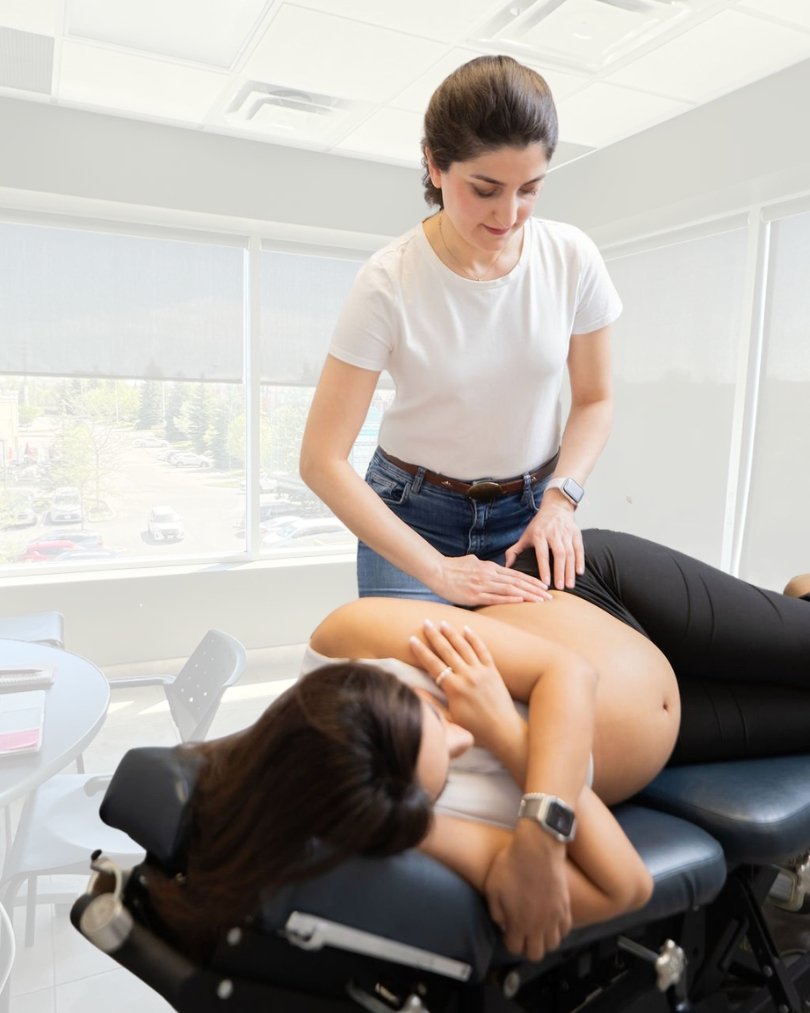
As a postpartum chiropractor, my approach to Mommy’s Thumb goes beyond just treating the wrist in isolation. I look at the whole picture, because your wrist doesn’t exist in a vacuum.
Postpartum chiropractic care for Mommy’s Thumb and wrist pain may include:
- Wrist and Thumb Joint Assessment: Gentle mobilization to restore proper movement mechanics to the affected joints.
- Soft Tissue Therapy: Reduces inflammation and tension in the tendons and surrounding muscles of the forearm, wrist, and hand.
- Whole-Body Assessment: Identifies any contributing factors elsewhere in the body that may be adding strain to the wrist and thumb.
- Postural Guidance: Practical advice on how to adjust your lifting technique, feeding positions, and daily movement patterns to reduce strain on the tendons.
- Ergonomic Support: Guidance on how to set up your feeding station, change table, and daily routine to protect your wrists while you heal.
The goal is not just to ease your pain right now. It is to support your body’s full recovery and help prevent this from becoming a chronic condition.
What Else Can Help?
Alongside chiropractic care, the following supportive measures are commonly recommended for Mommy’s Thumb:
- Rest and activity modification: Become mindful of how you lift and hold your baby. Try scooping your baby with your palms rather than leading with your thumbs, and use both hands to distribute the load.
- Ice: Apply to the base of the thumb and wrist for 10 to 15 minutes several times a day to help reduce acute inflammation.
- Wrist and thumb splint: A thumb spica splint holds the thumb and wrist in a neutral position, giving the inflamed tendons rest during daily activity. Many mamas wear one during feeds and while sleeping.
In more persistent cases, your GP or specialist may discuss anti-inflammatory options or corticosteroid injections. Surgery is rarely needed but remains an option for severe, unresponsive cases.
When Should You Seek Help?
The sooner, the better. Early intervention is key with Mommy’s Thumb: the longer inflammation is left unaddressed, the more the tendon sheath thickens and the harder it becomes to resolve without more aggressive treatment.
Please don’t wait until you can barely hold your baby. Please don’t dismiss it as something you just have to push through. Postpartum wrist pain is real, it is common, and it is treatable.
If you are in Aurora, Newmarket, Richmond Hill, Vaughan, or anywhere in York Region and you’re noticing thumb or wrist pain since having your baby, come in. Let’s assess what’s happening, create a plan, and get you feeling like yourself again.
Postpartum Wrist Pain FAQs
Can Mommy’s Thumb go away on its own?
While it is possible for Mommy’s Thumb to eventually resolve on its own once your baby becomes more independent and you are lifting them less frequently, leaving it untreated means it can take a very long time to improve. Because you have to scoop up and hold your newborn dozens of times a day, the tendons rarely get the rest they need to heal naturally. Actively releasing the tension from the compressed thumb tendons and surrounding forearm muscles is the fastest way to stop the constant cycle of irritation and speed up your recovery.
Does breastfeeding make Mommy’s Thumb worse?
Breastfeeding can definitely worsen the discomfort, and it comes down entirely to biomechanics. When you cradle your baby’s head for long feeding sessions, your wrist is often held in a flexed, bent position while your thumb stays extended to support their weight or position the breast. Holding this heavy, static position for 20 to 40 minutes at a time puts an incredible structural strain on the thumb tendons. If your feeding posture lacks proper support from pillows, your wrist muscles have to overcompensate, which directly accelerates the physical wear-and-tear on those specific tissues.
What can I do at home to help the pain?
Rest as much as possible by utilizing a baby carrier or wrap to reduce hand lifting. You can also apply ice to the thumb side of your wrist for 10 to 15 minutes to reduce acute swelling, and try to keep your wrist in a neutral, straight position whenever you pick up your baby.
This blog post is for informational purposes only and does not constitute medical advice. Please consult your healthcare provider for a proper diagnosis and personalized treatment plan.