
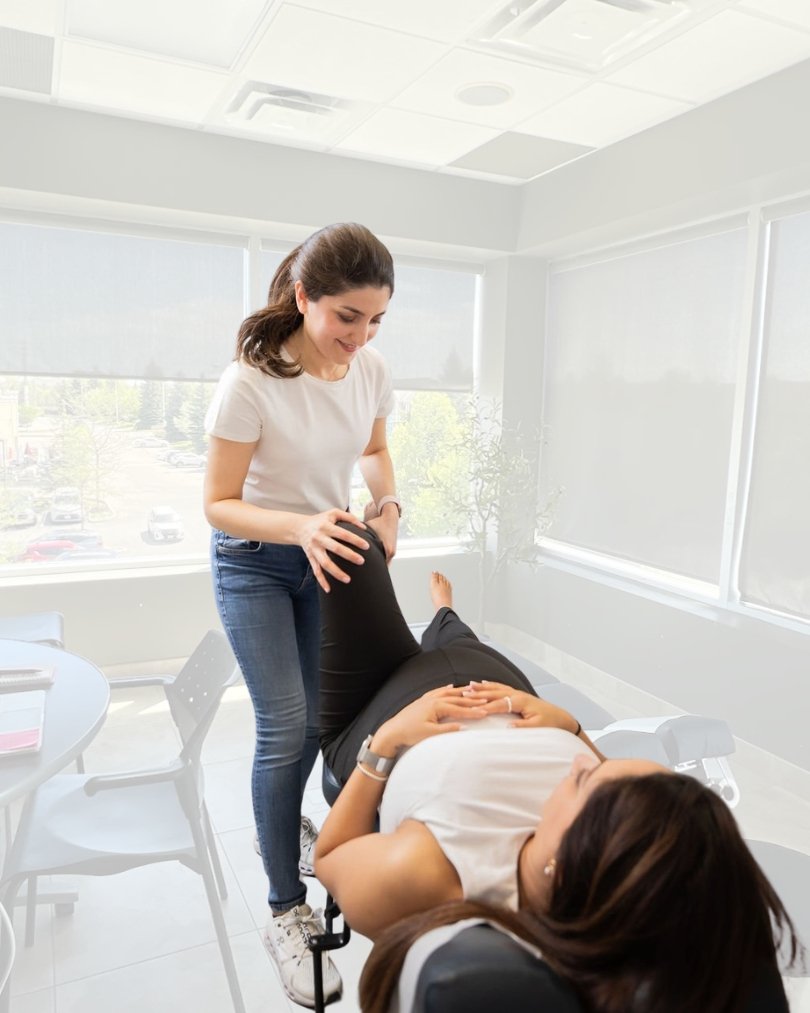
There is no single date that suits every new mother. At Vieno Wellness, Dr. Pegah usually starts care once your doctor or midwife has said you are ready for more physical activity. That is often around six weeks after a vaginal birth and around six to eight weeks after a caesarean birth. If something is bothering you sooner, she can sometimes arrange a gentle assessment earlier.
This article explains how that decision is made, what Canadian guidance and research say about recovery after birth, and when to speak to your doctor or midwife first. These early weeks are what we call the fourth trimester: your body is still recovering and your baby is new to the world.
After a vaginal birth
For a vaginal birth, Dr. Pegah usually offers a full assessment at around six weeks. By then the early recovery is well under way, and you have spent a few weeks lifting, feeding and carrying your baby, so it is easier to tell where your body is under strain.
Some mothers prefer not to wait that long. If you experience issues at two or three weeks, such as lower back, neck, pelvic, or wrist discomfort, you can request an earlier appointment. Dr. Pegah will conduct a thorough assessment and provide modified treatment tailored to your needs, or refer you to your doctor or midwife if necessary.
After a caesarean birth
A caesarean is abdominal surgery, and recovery takes time. The Society of Obstetricians and Gynaecologists of Canada (SOGC) advises avoiding heavy lifting for at least four weeks, which means nothing heavier than your baby, and avoiding driving for the first four weeks. It also advises against strenuous activity and core exercises such as crunches and planks for at least six weeks, and says most women can return to their normal day to day activities by about six weeks. The Public Health Agency of Canada (PHAC) gives a similar message. It advises lifting nothing heavier than your baby for the first six weeks, and talking to your health care provider about when to drive and what level of exercise is right for you (PHAC, 2023).
Dr. Pegah waits until your incision has healed and your doctor or midwife has cleared you for physical activity, which is usually around six weeks. If something is bothering you sooner, she can carry out a gentle assessment before that point. She does not perform any adjustment that puts pressure on your incision. You can read more about chiropractic care after a caesarean on our recovery page.
Your surgical team’s advice always comes first. If you are not sure whether you are ready for a visit, ask your doctor or midwife at your postpartum checkup.
What brings new mothers in
Back and pelvic pain after birth is common. Lower back and pelvic pain, neck and upper back tension from feeding, and sore wrists from lifting are the concerns new mothers most often bring to a postpartum visit.
Most mothers improve within three months. A 2025 review notes that most women recover from lower back and pelvic pain related to pregnancy within three months of delivery, while roughly 8 to 20 percent still have pain two to three years later (Özyurt et al., 2025). If your pain is not improving, or you feel low, anxious or worn out, tell your doctor or midwife as well.
Wrist and thumb pain is another reason mothers come in. We cover this condition, often called Mommy’s Thumb, in our guide to postpartum wrist pain.
What the research says about chiropractic care after birth
Research on chiropractic care after birth is still limited. A 2020 systematic review by researchers at the Canadian Memorial Chiropractic College in Toronto and colleagues in the United States looked at 16 studies. It found only a small amount of evidence and could not recommend any single option over another, although it rated the evidence from one trial of spinal manipulation or mobilization for postpartum low back pain as moderate and favourable (Weis et al., 2020).
More recent reviews look at care more broadly. A 2025 review of 37 randomized trials with 1,739 women reported short term pain improvement with stabilization exercises, which build control in the muscles around the spine and pelvis (high level of evidence), and with manipulative therapy and other exercises (moderate level of evidence), although results differed a lot from one trial to the next (Özyurt et al., 2025). Another 2025 review, by researchers at Canadian universities and covering 3,769 women, found moderate certainty evidence that exercise programs aimed at the trunk muscles were linked to less low back and pelvic pain and less disability in the first year after birth (Ruchat et al., 2025).
In 2022, 78 clinicians from seven countries, in a project that included researchers at the Canadian Memorial Chiropractic College, agreed on 71 recommendations for chiropractic care of pregnant and postpartum patients, covering informed consent, risks, working with other health professionals, examination and care (Weis et al., 2022).
Chiropractic care is one option among several, and the research is still growing. It is a decision to make together with your doctor or midwife.
What happens at a first visit
Every new patient starts with a full history and a gentle assessment before any care begins. For new mothers, Dr. Pegah looks at your spine, pelvis and hip, and she takes your birth into account, whether it was vaginal, assisted or caesarean. If something is outside her scope, she will refer you to the appropriate healthcare professional.
Your baby is welcome at every visit. If you do not have a caregiver or babysitter, please feel free to bring your little one along. Dr. Pegah provides a supportive environment so mothers can focus on their own health, even without extra help. Care is gentle and adapted to where you are in your recovery. Visits usually start weekly or every two weeks, and Dr. Pegah reviews how you are doing at each one before deciding what comes next.
In addition to maternal care, Dr. Pegah focuses on pediatric chiropractic care. A separate appointment can be booked whenever you would like your baby to receive a gentle assessment.
While you wait for your visit
Follow the activity limits your doctor or midwife has given you. After a caesarean, that means nothing heavier than your baby for the first four to six weeks (PHAC, 2023). When you lift your baby, try scooping with your palms instead of leading with your thumbs, and use both hands to share the load.
Gentle activity matters too. The 2025 Canadian guideline for the first year after birth recommends building up gradually towards at least 120 minutes a week of moderate to vigorous activity, spread over four or more days, with pelvic floor muscle training every day. After a caesarean or a tear, it advises starting with light activity and building up once the incision or tear has healed. Its Get Active Questionnaire for Postpartum helps identify the few people who should speak to a health care provider before they start (Davenport et al., 2025). Exercise aimed at the trunk muscles is also one of the better supported options in the research above (Özyurt et al., 2025; Ruchat et al., 2025). Ask your doctor or midwife what is right for you and when to start.
Common questions
Can I see a chiropractor two weeks after giving birth?
It depends on how you are recovering and what is bothering you. A full assessment usually takes place around six weeks. If you have a specific problem sooner, Dr. Pegah can arrange a gentle assessment, and she may ask you to check with your doctor or midwife first.
Can I go to a chiropractor after a caesarean?
Yes, once your incision has healed and your doctor or midwife has cleared you for physical activity. Dr. Pegah usually waits until around six weeks. A gentle assessment can take place earlier if you need one.
Is it good to see a chiropractor after giving birth?
Back, pelvic, neck and wrist pain are common in the first year, and chiropractic care is one option for mothers. So a first visit is mainly a chance to find out what is going on and whether care, or a referral to another health professional, makes sense for you.
Do I need a referral from my doctor?
No, a referral is not needed. Chiropractors are primary care doctors, so you can book directly.
Can I bring my baby to the appointment?
Yes. Babies are welcome at every visit.
Is it too late if my baby is already several months old?
No. Some mothers start care months after birth. Whether you are six weeks or six months postpartum, you can book a visit.
How many visits will I need?
It depends on how you are recovering. Care usually starts weekly or every two weeks, and Dr. Pegah reviews your progress at each visit.
Book a postpartum visit in Aurora
Vieno Wellness is in Aurora and welcomes mothers from Newmarket, Richmond Hill, Markham, Vaughan, East Gwillimbury and across York Region. To book a postpartum chiropractic visit, use the Book Appointment button, or contact us with any questions.